
October 15, 2026
Remote Broadcasting Services for Live Sports
Remote broadcasting has transformed how live sports are produced and distributed globally. SMW Remote delivers end-to-end remote broadcasting solutions that bring professional-grade production to any event, anywhere in the world.
What Is Remote Broadcasting?
Remote broadcasting is the process of producing and distributing live content — including video, audio, graphics and commentary — from a central hub rather than a full on-site production unit. Instead of deploying a large crew and equipment to every venue, the production team operates from a remote facility and receives live feeds from the event location.
This approach has become the preferred model for sports broadcasters, streaming platforms and rights holders who want broadcast-quality output without the overhead of traditional on-site production. SMW Remote specialises in delivering seamless remote broadcasting for sporting events of all sizes, from grassroots leagues to major international tournaments.
How Does Remote Broadcasting Work?
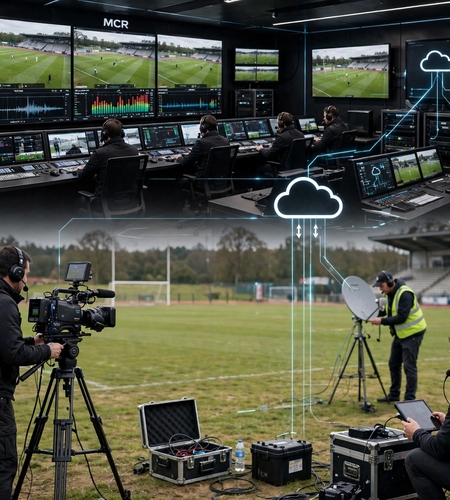
At the event venue, a lean camera crew captures multi-angle footage and sends live signals over dedicated fibre, bonded 5G or IP connections to a central production hub. From there, a full production team handles switching, graphics, audio mixing, commentary and encoding — all in real time.
The finished broadcast feed is then distributed to TV channels, streaming platforms, or both, depending on the rights holder's requirements. The result is indistinguishable from a traditional OB truck broadcast, but at a significantly lower cost and with far greater logistical flexibility.
Live Video & Camera Feeds
A robust camera setup at the venue is the foundation of any remote broadcast. SMW Remote works with experienced camera operators to deploy the right number and type of cameras for each sport — whether that's pitch-side cricket cameras, wide-angle football feeds or court-level kabaddi angles.
All camera signals are ingested, encoded and transmitted using low-latency protocols that preserve quality across any network condition. Redundant signal paths ensure that a single connection issue never interrupts a live broadcast.
Remote Audio & Commentary
Audio is just as critical as video in live sports broadcasting. SMW Remote's commentary teams work from professional booths equipped with broadcast-grade microphones, monitoring systems and clean feed integration — allowing them to deliver polished commentary as if they were sitting at the venue.
Natural crowd audio from the venue is mixed with commentary to create an immersive viewer experience. For events requiring multilingual coverage, separate commentary tracks can be recorded and mixed simultaneously.
Remote Production Control
The production control room is the nerve centre of any broadcast. In a remote setup, this control room is located at the production hub rather than on-site. Directors, vision mixers and technical operators manage camera switching, replays, graphics insertion and audio levels from a centralised workstation.
SMW Remote's production control workflows are built for reliability. Backup systems, redundant connections and experienced operators ensure that the broadcast remains smooth and professional from the first whistle to the final moment.
Graphics & Score Integration
Real-time graphics are a core part of the modern sports broadcast experience. From lower-third name bars and live scoreboards to animated statistics and player profiles, SMW Remote's graphics team builds and operates custom graphics packages tailored to each sport and broadcaster.
Data feeds are integrated directly into the graphics engine, allowing scores, match statistics and player data to update automatically throughout the broadcast. This reduces manual input and ensures accuracy throughout the event.
Replays & Highlights
Instant replays and post-match highlights are essential for modern sports coverage. SMW Remote operates dedicated server-based replay systems that allow operators to quickly call up key moments — boundaries, goals, tackles or controversies — with variable-speed slow motion.
In addition to live replays, the production team compiles highlights packages during and after the event. These are formatted for social media, broadcast segments and digital distribution to maximise the content value of every match.
Broadcast & Streaming Distribution
Once the broadcast feed is produced, it needs to reach audiences wherever they are. SMW Remote handles the full distribution chain — from satellite delivery to broadcasters, to live streaming via CDN to OTT platforms and social media channels.
Whether you need a single broadcast output or simultaneous delivery across multiple platforms and regions, SMW Remote's distribution infrastructure scales to match your audience reach requirements.
Remote Broadcasting vs Traditional On-Site Broadcasting
Traditional on-site broadcasting involves deploying an outside broadcast (OB) truck, a large crew and significant equipment to each venue. This model offers complete on-site control but comes with substantial cost, travel logistics and setup time — making it impractical for frequent or lower-budget events.
Remote broadcasting solves these challenges by centralising the production function. The venue footprint is dramatically reduced, travel costs fall significantly, and the same experienced production team can cover multiple events simultaneously. For leagues running fixtures across different venues on the same day, the cost and quality advantages of remote broadcasting are substantial.
Remote Broadcasting for Live Sports
Live sports is the ideal use case for remote broadcasting. Matches are scheduled in advance, venues are known, and the demand for consistent broadcast quality is high. SMW Remote has delivered remote broadcasting for cricket, football, kabaddi and other sports across Europe, Asia and Africa.
From domestic league fixtures to international bilateral series, the remote model allows federations and leagues to broadcast every match without the cost of deploying a full OB operation to each venue. This has opened up broadcast coverage to smaller tournaments and developing cricket nations that previously could not afford traditional production.
Remote Sports Broadcasting Workflow
A typical remote sports broadcast begins with pre-production planning: technical recces, signal routing design, commentary brief preparation and graphics build. On match day, the venue team establishes camera positions and sends test signals to the hub. Once the connection is confirmed and production checks are complete, the broadcast goes live.
Throughout the event, the production hub runs continuously — managing feeds, calling replays, inserting graphics, mixing audio and monitoring signal quality. At the conclusion, a review of the recording is completed and highlights packages are prepared for downstream distribution.
Frequently Asked Questions
What is remote broadcasting?
Remote broadcasting is the production and distribution of live content from a central hub rather than on-site at the venue. Camera feeds are transmitted from the venue to a remote production facility, where the broadcast is assembled and sent to TV channels and streaming platforms.
How does remote broadcasting work?
Camera operators at the venue send live signals over IP, fibre or bonded 5G to a remote production hub. The production team at the hub handles switching, graphics, commentary, audio mixing and encoding before distributing the final broadcast feed.
What is the difference between remote broadcasting and traditional broadcasting?
Traditional broadcasting deploys a full OB truck and crew to every venue. Remote broadcasting centralises the production function at a hub, reducing on-site crew size and equipment significantly. Both deliver broadcast-quality output, but remote is more cost-effective and scalable.
Can remote broadcasting be used for live sports?
Yes. Remote broadcasting is widely used for live sports, including cricket, football, kabaddi and more. SMW Remote delivers end-to-end remote broadcasting for domestic and international sporting events across multiple continents.
Can commentary be produced remotely?
Absolutely. Commentary is one of the core components of SMW Remote's remote broadcasting service. Commentators work from professional booths with full audio and video monitoring, delivering live commentary that integrates seamlessly into the broadcast.
Work with us
Ready to work with SMW Remote?
Talk to our team about your next production, broadcast, or sponsorship project.
Get in Touch →